“Search me, O God, and know my heart! Try me and know my thoughts!” — Psalm 139:23
“Each of us will give an account of himself to God.” — Romans 14:12
Conviction is necessary.
Clarity is necessary.
Speaking when conscience requires it is necessary.
But no man sees perfectly.
Scripture reminds us that we see in part. Our knowledge is real, but it is partial. Our judgments may be sincere, yet incomplete. Even our strongest convictions must remain under examination.
There is a danger in being frequently correct.
A man may grow accustomed to trusting his analysis. He may begin to feel settled in his conclusions. He may quietly assume that disagreement must stem from weakness in others rather than limitation in himself.
But the Psalmist prays differently.
“Search me, O God.”
That is not the prayer of a man confident in his own infallibility. It is the prayer of one who knows that self-deception is possible.
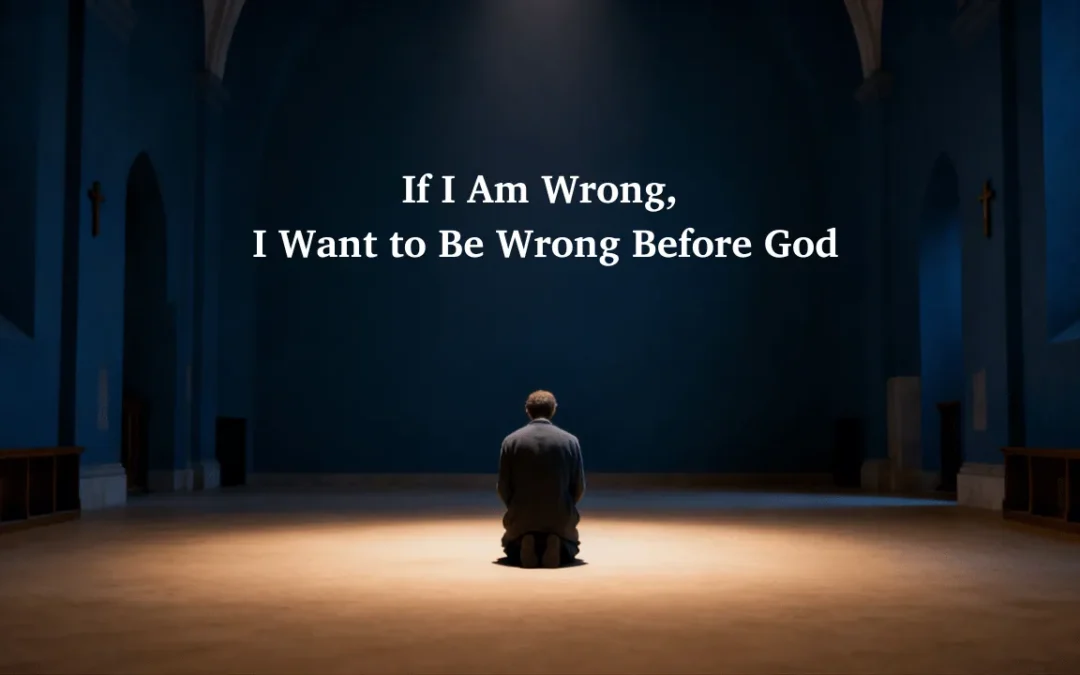
To say, “If I am wrong, I want to be wrong before God,” is not relativism. It is submission.
It means this: I would rather be corrected by Scripture than defended by pride. I would rather be exposed now than vindicated later only to discover I misjudged.
Romans reminds us that each of us will give an account. Not for others. For ourselves.
On that day, clarity will be complete.
Motives will be revealed.
Tone will be weighed.
Intentions will be examined.
What seemed urgent may be shown trivial.
What seemed minor may be shown weighty.
The fear of that day steadies a man.
It tempers certainty with humility.
It reminds him that being right is not the ultimate goal.
Being faithful is.
Christ alone judges perfectly.
He knows where we spoke too quickly.
He knows where we remained silent too long.
He knows where zeal exceeded wisdom.
He knows where fear restrained courage.
To desire to be wrong before God is to invite correction now. It is to ask that Scripture interrupt pride. It is to welcome counsel. It is to hold convictions firmly, yet with open hands.
This does not mean indecision.
It means accountability.
The man who fears God will say, “If I must err, let it not be in rebellion. Let it not be in self-exaltation. Let it not be in stubbornness. Let me err, if I err, in sincere submission to Your Word.”
Such a posture protects the soul.
It keeps conviction from becoming arrogance.
It keeps reform from becoming self-righteousness.
It keeps building from becoming self-glorification.
Christ stands as Judge and Shepherd.
Before Him, all arguments cease.
Before Him, all platforms dissolve.
Before Him, only obedience matters.
And so the mature believer walks carefully — speaking when necessary, correcting when required, building where assigned — yet continually praying that if he is mistaken, the Lord would correct him now, shape him gently, and keep him from the far greater error of pride, for it is better to be humbled under God’s searching light than to stand vindicated before men and corrected before Christ.