The Perfectly Blessed Man
“Blessed is the man” — so begins Psalm 1. The Psalm opens not with activity, but with identity. It describes a man, and it first tells us what he does not do: He does not walk in the counsel of the wicked, nor stand in the way of sinners, nor sit in the seat of scoffers.
There is progression here — walking, standing, sitting. Counsel becomes companionship; companionship becomes settled belonging. The blessed man refuses this downward drift.
But Psalm 1 is not merely about avoidance. It is about affection. “His delight is in the law of the LORD, and on His law he meditates day and night.” Here is the true picture of repentance: not only turning away from evil counsel, but turning toward God with delight. Not merely distancing oneself from corruption, but finding joy in divine instruction.
Yet we must say something honest and necessary: No mere human being has ever done this perfectly.
No man has delighted in the law of the LORD without interruption, without wandering thought, without cold affection.
Except One. The Lord Jesus Christ is the perfectly blessed Man.
He did not merely avoid wicked counsel — He fulfilled the law in flawless obedience. He did not merely meditate upon God’s Word — He embodied it. The Word became flesh. Where Adam failed, and where we continually fall short, Christ stood firm.
More than that: the One who was truly fruitful was treated as chaff. The One whose leaf never withered was cut down. He bore the curse reserved for the wicked so that those united to Him might share in His blessedness.
Psalm 1 finds its fullest meaning in Him.
The Planted Tree
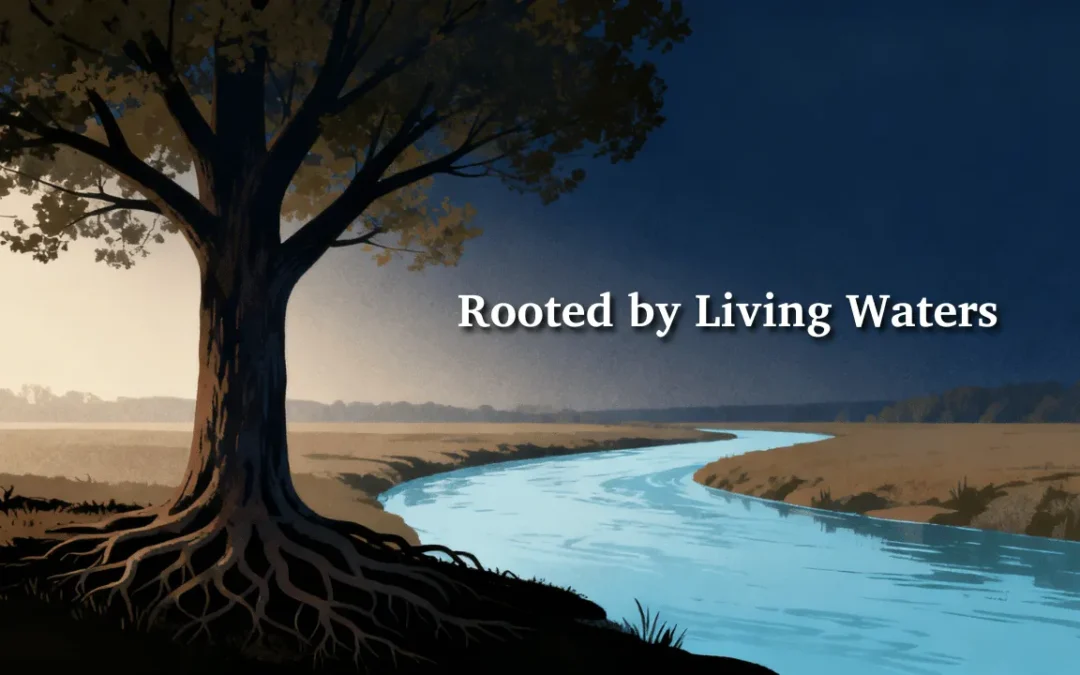
The Psalm continues: “He is like a tree planted by streams of water, that yields its fruit in its season, and its leaf does not wither.” This is not a wild tree struggling in drought. It is planted — intentionally placed — beside life-giving water.
Our Lord later declared: “A good tree cannot bear bad fruit, nor can a bad tree bear good fruit” (Matthew 7:18).
And again: “I am the vine; you are the branches… apart from Me you can do nothing” (John 15:5).
Not only is Christ the true Vine; He is also the source of living water (John 7:37–39). The fruitful tree of Psalm 1 is fruitful because it draws from Him. Union with Christ is the hidden root of all spiritual vitality.
Jude warns of false professors as “trees without fruit, twice dead, plucked up by the roots.” The contrast is sobering. One is alive because it abides. The other appears for a moment but lacks living connection. The difference is not busyness. The difference is root.
The Noise of Our Age
We live in an age of noise. Ours may be one of the most distracted, disorganized, and hurried generations in history. We fill our days with tasks, notifications, content, meetings, and endless scrolling. We excuse ourselves: “Life is simply busy.”
But we must ask: busy for what?
Is not our busyness often a search for the very thing Psalm 1 describes — a blessed life? A life that feels full, meaningful, secure, and joyful? In our pursuit of happiness, we are tempted to envy the wicked when they prosper (Psalm 73:3). We are tempted to consult their counsel, stand in their pathways, and sit among their mockery.
The way of the wicked, however, is described as chaff — weightless, rootless, driven by the wind. There is activity, but no substance. Motion, but no stability. Psalm 1 does not forbid engagement with unbelievers — our Lord Himself ate with sinners. But it forbids adopting their worldview, their counsel, their settled posture toward God. There is a difference between mission and immersion. The question is not whether we are near the world. The question is whether we are rooted in Christ.
Choosing Our Counsel
The Scriptures repeatedly urge us to choose our guides wisely. There is wisdom from above and wisdom from below. There is truth and there is vanity. Today, countless voices promise insight — on relationships, wealth, identity, success. Yet many of these voices lack the fruit of covenant faithfulness, humility, and reverence for God. The form of wisdom is present; the fear of the LORD is absent.
Psalm 1 begins with counsel because what shapes our thinking shapes our lives.
It is wise, therefore, to filter what enters our minds. To withdraw from unnecessary noise. To step away from distraction.
To meditate. Not occasionally. Not when convenient. But day and night. This does not belong only to pastors or theologians. Meditation upon God’s Word is not a luxury for the vocationally religious; it is the lifeblood of every believer.
The Psalmist could say: “I have more understanding than all my teachers, for Your testimonies are my meditation” (Psalm 119:99). Understanding is not produced by information overload. It is formed through sustained reflection upon divine truth.
The Blessed Life Reconsidered
The world defines blessedness as prosperity, influence, applause, or visible success. Scripture defines it as rootedness in God. The Apostle Paul begins his letter to the Ephesians with doxology: “Blessed be the God and Father of our Lord Jesus Christ, who has blessed us with every spiritual blessing in the heavenly places in Christ” (Ephesians 1:3).
Notice the location of blessedness — in Christ.
The perfectly blessed Man shares His blessedness with those united to Him.
The question for us is not merely whether we profess faith, but whether our lives show evidence of living connection to Him.
Do we wake with consciousness of God? Do we hunger for His Word? Do we examine ourselves honestly? Or do we still long for fellowship with the world’s counsel?
An Invitation to Slow Down
It takes great virtue to slow down. To ponder. To meditate deeply rather than skim endlessly. To allow Scripture to reorder our affections. Dear believer, let us not take lightly the means of grace. Let us not treat meditation as optional while expecting fruitfulness as automatic.
Christ, the Messiah, the Son of God, delighted in His Father’s will. As true Man, He treasured the Scriptures that testified about Him. We are in Him. Therefore we follow Him — not merely in outward conduct, but in inward affection.
May we examine ourselves, that we may be found in the Beloved. May we be planted by living waters. May our leaf not wither. And may our blessedness be nothing less than communion with the Perfectly Blessed Man — Jesus Christ.