
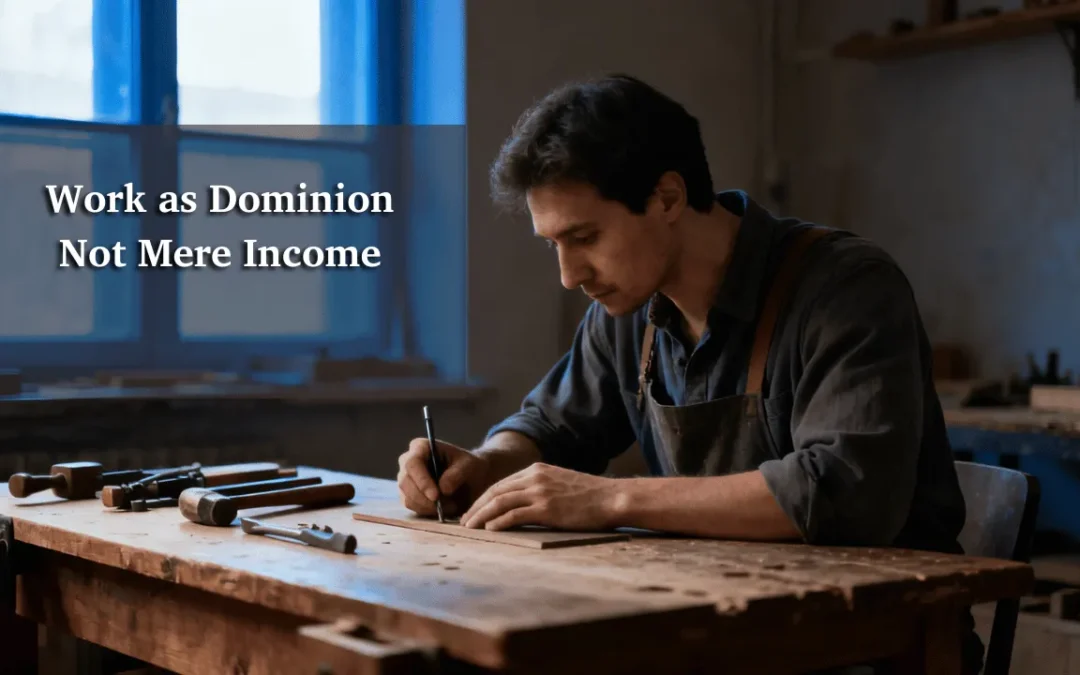
Modern life has reduced work to a transaction.
We work to earn. We earn to consume. We consume to maintain comfort. And in that cycle, vocation quietly loses its dignity.
But Scripture presents a far larger vision.
Before sin entered the world, before thorns and sweat complicated labor, God gave Adam a task. He was to cultivate and keep the garden. Work is not a punishment. It is part of creation order. It reflects the image of a working God.
To labor faithfully is to participate, in creaturely measure, in God’s ordering of the world.
The cultural mandate was not revoked after the Fall. It was complicated, but not erased. Humanity still builds, plants, designs, organizes, teaches, trades, governs, and crafts. The question is not whether we will exercise dominion, but under whose authority we will exercise it.
When work becomes merely a paycheck, its horizon shrinks. But when work is understood as stewardship under Christ’s Lordship, even ordinary tasks gain weight.
Dominion is not domination.
It is responsible cultivation.
The farmer cultivates soil.
The teacher cultivates minds.
The engineer cultivates systems.
The pastor cultivates souls.
The parent cultivates children.
Each sphere carries accountability before God.
Work done without reference to the Creator often drifts into self-exaltation or mere survival. But work done under submission becomes an act of obedience.
This does not mean every job feels noble. Many forms of labor are repetitive, constrained, or financially pressured. Yet even within imperfect systems, the believer may still labor as unto the Lord.
There is also a danger on the other side.
Some Christians, reacting against materialism, begin to treat business and economic strength with suspicion. But Scripture does not condemn productivity. It condemns greed. It does not forbid profit; it forbids idolatry.
The Proverbs commend diligence. Paul commands quiet industry. Wealth, when stewarded rightly, can strengthen families, churches, and communities. But it must never replace trust in God.
Dominion without submission becomes tyranny.
Submission without dominion becomes passivity.
Christian vocation lives in the tension of both.
In every spreadsheet, lesson plan, contract, design draft, construction project, or strategic decision, the question is not simply “Will this succeed?” but “Does this reflect faithful stewardship?”
Christ is Lord not only of prayer meetings but of payrolls.
He is Lord of business strategy, technological development, marketing campaigns, and long-term planning.
If He is Lord of every sphere, then our work must be shaped accordingly.
A man may change jobs, industries, or roles throughout his life. But he does not change masters.
He labors under Christ.
When work is reduced to income alone, frustration increases. When it is elevated to identity, pride increases. But when it is received as stewardship, stability increases.
The Christian does not work merely to escape poverty nor to chase prestige. He works to cultivate what God has entrusted to him — whether little or much.
The measure of success is not applause, but faithfulness.
And faithfulness in labor, over decades, becomes quiet dominion.